

For two years our website called us “a development studio of software engineering experts.” Buyers took us at our word. We got invited into processes written for a different kind of company, won the technical evaluation, and lost anyway. The work we actually win looks nothing like that.
The problem was never the work. It was the shelf buyers put us on, and we had put ourselves there.
So this summer we repositioned the company. Eight weeks, fourteen recorded sessions (three of them before we even had a method), and AI agents attacking every draft along the way. The answers themselves stay inside the company. What follows is the process, and what it cost us to learn it.
Why this method
We had spent those three June meetings arguing about what to call ourselves. Agency, consultancy, studio. Every meeting produced a new label and no way to choose between them. A brand agency would have handed us a word without knowing our domain, and a word without the reasoning behind it was exactly what we already had. We’d also just proved we couldn’t find one in a meeting.
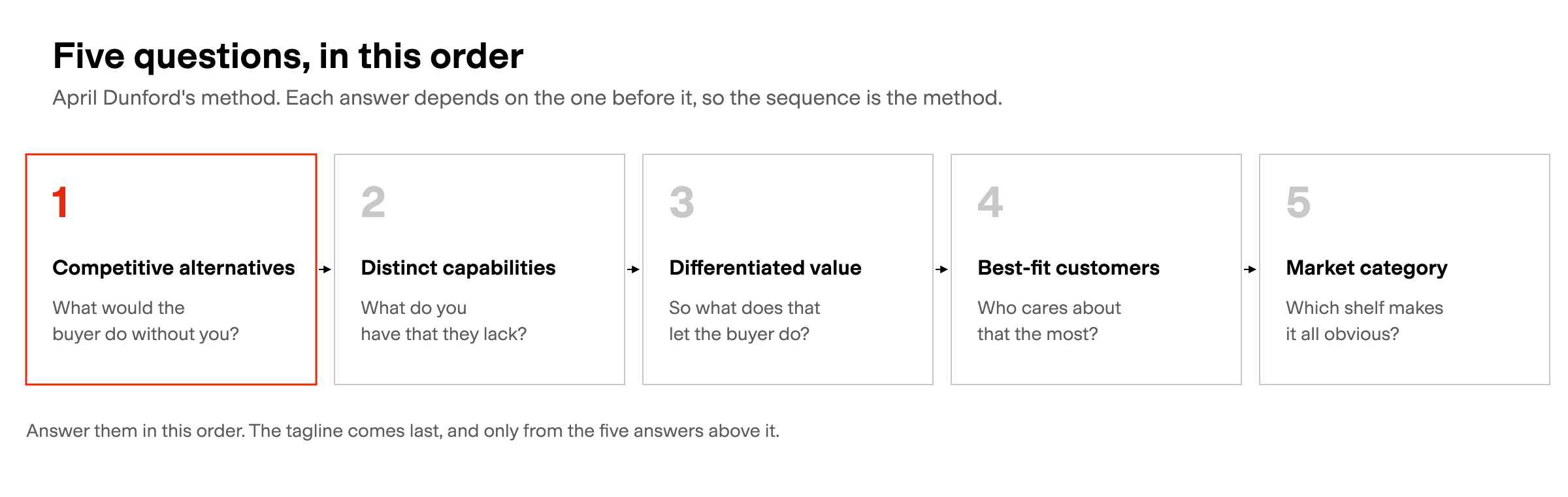
April Dunford’s Obviously Awesome worked for us because it refuses to start where we had started. You never write a positioning statement. You answer five questions in a fixed order, and the name comes out at the end. Each answer depends on the one before, so if you start at the end (as we had), every upstream answer bends to fit the name. There was a second, more practical reason. The method is a process with checklists rather than a template with blanks, which meant we could hand it to an AI agent and have it police us. The definitions and rules of the five questions below are Dunford’s. The learnings are ours. A few other sources show up further down, where they did their work, and all of them are listed at the end.
We wrote the answer first, and it didn’t survive
In early July we wrote a value proposition ourselves, before the team had looked at a single question. The conclusions were in our heads, so we wrote them down as if the work were done.
Before anyone else saw it, we had 25 AI agents take it apart. Setting that up and running it took a day. Some of the agents analysed the draft question by question. Some were told only to attack it. Others checked whether each attack actually held up, and a small panel scored the categories the draft implied.
Two problems survived all of that. The draft compared us with the wrong rival. And it never said what kind of company we are, so a reader would file us exactly where we didn’t want to be. Neither had occurred to us, which is a little embarrassing to write down. The panel added the obvious. A position written by the founders alone is one the team never owns. We shelved the draft and started the five questions from the beginning, with everyone in the room this time.
One more thing went in before we started. The five questions and a checklist for each became part of the instructions for the AI agent that works in our repository, so every draft it touched got checked against them. Two of the lines, exactly as written.
- [ ] Consider "doing nothing" as an alternative. It's almost always an option.
- [ ] List only provable capabilities. Skip anything hard to prove or that's
      really a benefit, not a feature.
When a draft smuggled a conclusion into the wrong question, the checklist caught it. A framework you have to remember gets skipped the moment there’s pressure, and there is always pressure.
The setup mattered more than the framework
Two decisions before the first team session did more for the result than anything in the book. One rule kept the sessions on track.
Position for a live deal, not for the website. The output is not what goes on the homepage. It’s what we say in the deal we’re working right now, so that it closes. Dunford’s word for that person is the champion, the one buyer who leads the purchase and decides who makes the short list. Every abstract identity argument afterwards got settled by asking what we would actually tell them.
Answer alone, collect blind. Every question was homework first. Founders, sales, engineering and product filled in the framework independently and pasted their answers onto a shared Mural board, hidden from each other until we clustered them. Everyone knows the failure mode as groupthink. Brainstorming researchers call it collaborative fixation, the first idea said out loud narrows everyone else’s, and they’ve been measuring since the 1980s that people who write alone and pool afterwards produce more ideas, and more distinct ones, than the same people talking in a room. Design sprints turned that into a rule they call working alone together. We still got caught, in a smaller way. The facilitator’s own answers sat at the top of the board, and he noticed the anchoring himself. “The top ones are mine. That is my bias right there.”
Stay on one question. Sessions drift. Ours kept sliding from alternatives into differentiators into market sizing into a tagline, and every slide cost us a session. The line that stopped it, “the messaging is not what we’re solving here,” was unpopular and correct.
The five questions, and what each one taught us
1. What would the buyer do without you?
We led with our favorite line on a sales call. The prospect didn’t argue with it. He just didn’t react, and moved on. That’s the worst result a positioning line can get, worse than an objection, because an objection at least means he cared enough to push back. If your best line can be met with a shrug, it isn’t doing any work. The line we tried next got a question back, and that question became the seed of our differentiation. One real buyer decided it before the workshop could.
The theory is short. The buyer judges “better” against whatever they’d use instead, so you list only real alternatives, seen in actual deals, starting with the status quo and including doing nothing. A company that looks like you and markets like you but has never shown up in a deal is a ghost, and you can’t differentiate against a company that doesn’t exist.
This question ended three weeks of identity debate in one session. It changes the subject from “who are we” to “what would the buyer do without us,” and the second question has evidence behind it. The first one never will.
2. What do you have that the alternatives lack?
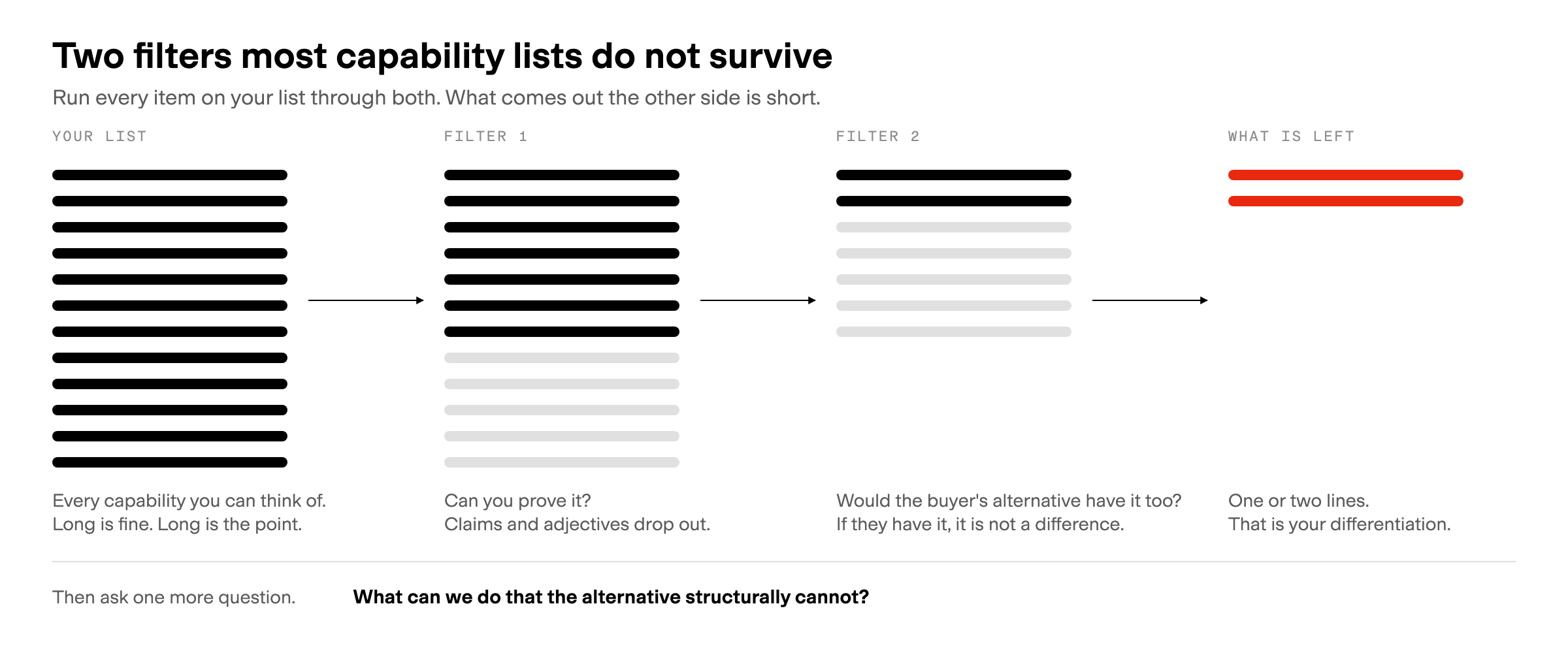
Capabilities, not benefits, and only provable ones. “World-class talent” is a claim. Public commit history is a capability.
Our own learning here was a second filter, built from the answer to question one. Would the buyer’s alternative also have this? It killed most of our list. Project management, ecosystem knowledge, “long-term partnership”, “we run on AI ourselves”, all of it went, because the alternative either had it too or nobody could prove it.
The strongest card had never appeared in any earlier draft, because it wasn’t a skill at all. Only one question surfaces that kind of card. What can we do that the alternative structurally cannot?
3. So what?
Value alone doesn’t win. Differentiated value does, meaning the benefit the buyer gets from you and can’t get from the alternatives. You keep asking “so what” until you reach more income, less cost, or lower risk, then you write the line somewhere between the raw feature and that endpoint.
We raced three framings of our top theme. Two of them died in a sentence each. Credentials died because the buyer’s answer to credentials is “and?” Process died because, as my co-founder put it, “a large consultancy also says it has a process.” The third one survived.
4. Who cares the most?
The buyers who feel the pain most acutely, and only then the ones with budget and a realistic path to reach them. If you got it right, they understand you fast and rarely negotiate.
We started listing companies before defining characteristics, caught it mid-session and reversed, because otherwise you reverse-engineer the profile from the logos you’d like to have. Along the way we had to remind ourselves that the buyer is a person with a budget, never the corporation around them.
Then a whole class of accounts came off the target list. What removed them wasn’t their size or sector. It was how they buy.
We gave up revenue we could see for revenue we can’t see yet. That was the hardest hour of the eight weeks.
5. Which shelf makes all of this obvious?
The category is the shorthand buyers use to file you, and it triggers assumptions about your competitors, features and pricing whether you intend it or not. It comes last because you can’t pick the container until you know what goes in it.
We got stuck twice here, and both times taught us more than the answer did. The first stall was conflating category with tagline. Our working test had somehow become “if we can’t put it in the homepage headline, we don’t have a category.” That test asks one phrase to do two jobs. The category makes you legible. Being better is a different argument, and it can take a paragraph.
The second stall was naming the category from inside the room. My co-founder stopped it himself. “I can’t make that bet. I don’t know which categories actually exist in buyers’ heads.” Inventing a name is more fun than researching one, so the room kept drifting back there.
What got us out was treating “which shelves exist” as a research question and reading what competitors actually print. We pulled the live homepage headlines of 34 companies in the space around us and classified each on the Anderson and Narus scale, which runs from generic benefits anyone could claim to one or two differences with evidence behind them. One identical phrase appeared on 7 of the 34 sites. Anything 7 companies already say can’t distinguish an eighth, but we hadn’t counted before. And 23 of the 34 headlines opened with a claim that was generic or unproven. The claim nobody makes with proof behind it is where a position can go.
The category research itself ran as deep-research agents with the failure condition written into the brief before they started. From our positioning file, “finding nobody on either side is a red flag that the pond doesn’t exist, not proof that it’s ours.” Pre-registering the kill signal is the only thing that stops a research agent from telling you what you hoped to hear.
Every sentence that shipped was argued over by people in a room. The agents attacked it, judged it and researched around it. Nobody let them write.
I’m not printing our category. Like the rest of the answers, it stays inside the company.
Then a sales call, never a landing page
When a landing page fails you can’t tell whether the positioning was wrong, the copy unclear or the design poor. So the position goes into a pitch, built by the same team that built the position, and gets run live with qualified prospects. Steve Blank’s rule applies. Nothing is final until it survives contact outside the building. When the same part fails twice, the position needs changing, however good the words are.
Under the lid
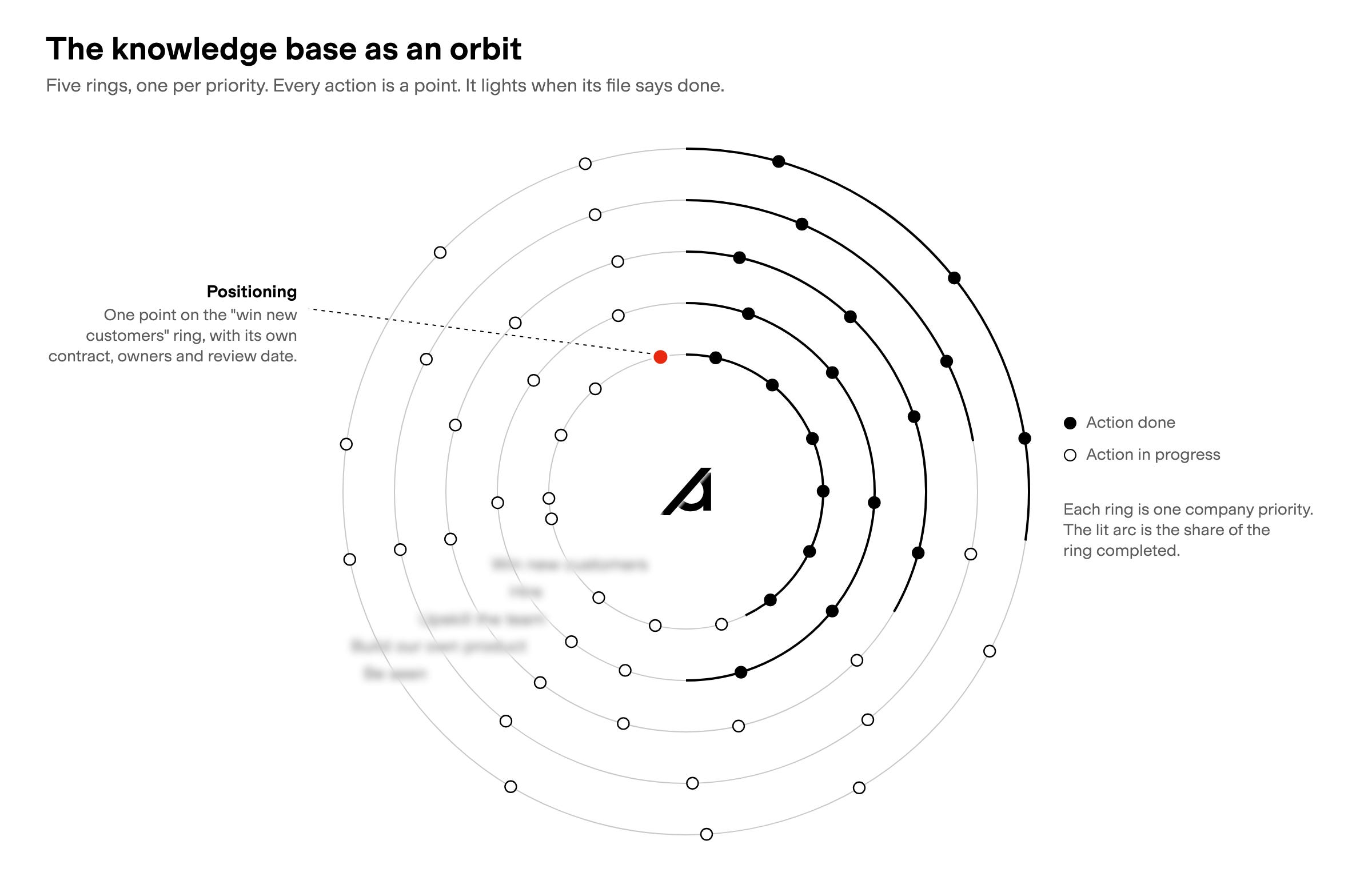
While the positioning ran, we were building a knowledge base at Apoco. Podcasts, talks and books get processed into what we actually concluded from them, in a form a person can browse and an agent can query. We have five priorities right now, and every action in the base is tagged with the ones it serves. Its state is one line in its markdown file.
The browsable view of all this is an orbit. Five rings, one per priority. Every action and every process is a point on its ring, and actions light up when the file says done. Positioning sits there as one point on the “win new customers” ring. The theory stays in the knowledge base. A one-page contract says how we run it. A thin skill lets an agent execute it.
The next point to light is the pitch. It gets assembled from the position in days, tested in real conversations for weeks, and recertified on a date, and the five questions rerun whenever the market moves or we outgrow the answer. None of it is finished, and it isn’t meant to be. The file keeps the record of every turn.
Eight weeks in, the most valuable output isn’t the paragraph. It’s that when anyone challenges the position (a buyer, an investor, one of our own engineers) we can lay out every card. What we ruled out, what killed it, and what evidence would reopen it. That’s what “positioning is a business decision” actually means.
Which revenue can you see today that your position says you shouldn’t take?
Sources
April Dunford, Obviously Awesome: How to Nail Product Positioning so Customers Get It, Buy It, Love It, 2nd edition, 2026. The five questions and the test in a sales pitch.
April Dunford, Sales Pitch: How to Craft a Story to Stand Out and Win, 2023. The champion.
James C. Anderson, James A. Narus and Wouter van Rossum, “Customer Value Propositions in Business Markets,” Harvard Business Review, March 2006. The three levels of value proposition and the rule of at most two substantiated points of difference.
Steve Blank, The Four Steps to the Epiphany, 2005. Get out of the building.
Michael Diehl and Wolfgang Stroebe, “Productivity Loss in Brainstorming Groups: Toward the Solution of a Riddle,” Journal of Personality and Social Psychology, 1987. Nominal groups produce more ideas, and more distinct ones, than interacting groups.
Nicholas W. Kohn and Steven M. Smith, “Collaborative Fixation: Effects of Others’ Ideas on Brainstorming,” Applied Cognitive Psychology, 2011. Hearing others’ ideas narrows your own.
Irving L. Janis, Victims of Groupthink, 1972. The term.
Jake Knapp, John Zeratsky and Braden Kowitz, Sprint, 2016. “Work alone together.”